
Lesser Whitethroat, Burnham Overy (Norfolk, UK), 18th September 2014
Back in the 1990s we used to see autumn Lesser Whitethroats that looked a bit different from the typical early-autumn western birds - often they would have quite warm colours on the wings, one I remember being so strongly rufousy that I thought it was a Whitethroat for a second. I was told they were Siberian Lesser Whitethroats of the race blythi. Then there was a decree that Siberian Lesser Whitethroats were unidentifiable, even in the hand - in fact if I remember rightly it was even claimed that they were not a valid taxon. Interest waned a bit but more recently things have taken a turn - they are a valid taxon, and may even by a full species - and some of them might even be identifiable in the field.
I hadn't had time to read the relevant chapter in Martin Garner's new book when I was faced with my first blythi candidate this autumn, and I wasn't prepared. First day I saw it I just thought it was a western. Some things looked a bit interesting, but it didn't stand out enough. Mind you, there was a lot of white in the tail, so I took some photos and resolved to read up that night. Busy days (easterlies) and busy nights (warm, lots of moths) meant I didn't get round to that before the time I next saw it, but this time I looked harder.
This time I noticed that while sometimes it looked very grey-headed, there was a pretty obvious extension of brown up the nape and on to the back of the head. The underparts were strongly sullied leaving a clear white throat and the tertials had a good degree of warmth in the colour. Weren't they pro-blythi features? Not as brown-headed as one I'd seen photographed recently, but was that enough to force it into the curruca mould? I wasn't sure, and most other birders on site were only interested in the Red-breasted Flycatcher and Yellow-browed Warbler frequenting the same area.
A quick tweet generated a few responses, generally not very encouraging from a blythi-perspective, but not conclusive. It's taken me a week to get to sorting the photos out and read up, but in the end I think the naysayers were probably right. Whatever, it's been a learning experience, and that makes it worthwhile. I'm still not clear on the validity or practicability of some of the features, but that just means there's still more for me to learn. Let me know if you think I've missed or misinterpreted anything.
- Head/nape - at times it looked very grey-headed, even wholly grey-headed, but at other times the brown looked pretty extensive. Never as extensive as it can be on blythi though, and on balance pretty much fine for curruca, I think. Unsurprisingly the brown was easiest to see from behind.
- Underparts - sullied throughout with a warm buffish wash on the flanks and vent, quite strong on the rear flanks. Greyer centrally but usually contrasting against the purer white throat. In some views/angles the contrast was much reduced but generally it was pretty noticeable, and the white never extended down on to the breast, as I think it normally does in curruca.
- Upperparts and wings - at some angles these generally looked pretty brown-grey, not much different from typical curruca. The tertial edges were a bit warm-toned - certainly warmer than some curruca, but whether it was enough to really suggest blythi I'm not sure. Again it varied according to light and in some photos it looks very unimpressive.
- Tail - the tail feathers look pretty pointed to me (clearly visible in some of the photos) so I think it's a first calendar-year bird. The inner web of the outer tail feather was extensively white, or at least whitish. When the tail was fully fanned it was possible to see a dark wedge on the inside edge of the inside web, but the rest of the inner web was pale. Not white though, although it looked like it in the field. In the photos you can see that it's off-white, greyish white and distinctly greyer than the pure white outer web (except at the tip which was pure white). If I've understood things correctly tail pattern is variable and this is more white than is normal for curruca, but for it to be a good pointer towards blythi the greyish white on the inner web would have had to be pure white. Am I right about that?
- Wing formula - I thought that with some spread-wing photos I might be able to do something with this, but I can't. If you're drawing a line to see whether P2 is level with P5/P6 or P6/P7 how do you know what angle to draw the line at? And is it safe to do so anyway, given that you wouldn't know exactly what plane the wing is in compared to the camera? Is it possible to interpret wing formula without having the bird in the hand?
- Call - I didn't personally hear it call. Let me know if you did.

Lesser Whitethroat, Burnham Overy (Norfolk, UK), 18th September 2014
Although most of the upperparts are obscured by blackberries, this picture shows the warmth that was often apparent on the tertial better than most. You can also see the brown extending up the nape, but looking pretty indistinct here.


Lesser Whitethroat, Burnham Overy (Norfolk, UK), 18th September 2014
In these two images it looks pretty much like a bog-standard curruca! No hint of brown in the head from this angle and the contrast between the white throat and dirty underparts isn't even apparent here. From this angle there's no sign of the warmth in the wings.

Lesser Whitethroat, Burnham Overy (Norfolk, UK), 18th September 2014
The brown on the head and nape was easiest to see from this angle, but it never looked as extensive as I would have expected to see on a stronger blythi candidate. Not sure how much variation there is in either taxon in respect of this fieldmark.


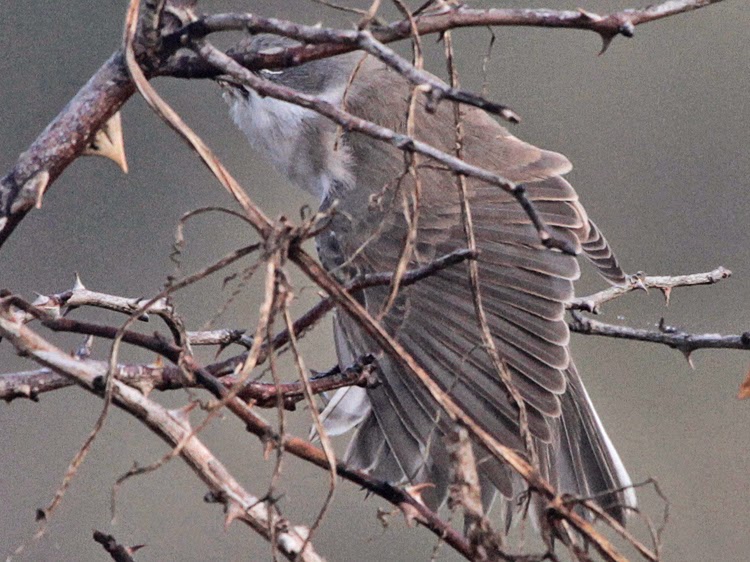


Lesser Whitethroat, Burnham Overy (Norfolk, UK), 18th September 2014
The tail feathers are pointy, making this a bird of the year I think. Note the outer tail feather pattern - extensively pale on the inner web but not pure white. I can't do anything with the wing formula - can you?


Lesser Whitethroat, Burnham Overy (Norfolk, UK), 18th September 2014
Looks pretty cold in these shots and the upperparts don't really give much reason for blythi-thinking, except perhaps in how pale it looks. It didn't really look this pale in the field, but nor did it look so cold - shows how misleading photos can be. Notice how the brown on the head appears and disappears with just a slight change of angle. The underpart colour also varies - in the field I thought it more obvious and this was one of the things that got me wondering about blythi the most.
Didn't manage to get any decent photos over the next couple of days, but for what they're worth (if anything), here's what I did get.

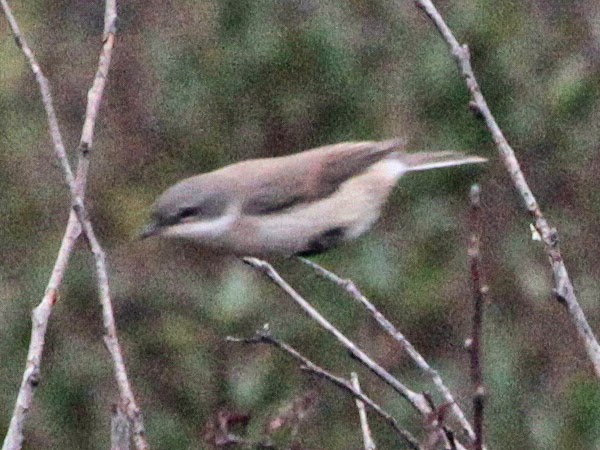

Lesser Whitethroat, Burnham Overy (Norfolk, UK), 20th September 2014
In conclusion I think this is very probably a western curruca, and at the very least not identifiable as a Siberian blythi based on what information I can glean. There was enough about it to make me think though, and I'm glad I asked the question. It's made me learn a bit, and that's given me some pointers as to what to look for with future Lesser Whitethroat encounters.
*** Update 2nd October ***
I'm interested to see photos of the Lesser Whitethroat currently present at Portland. This bird was trapped and is considered by some to be possibly a blythi and by others to be definitely a blythi. I've not seen it, but from the photos it looks strikingly similar to the Burnham Overy bird in a lot of ways. It looks different in different photos, as does the Burnham one, with some looking more brown headed and others looking very grey-headed. It looks to be a colder greyer looking bird than the Burnham one, consequently with less contrast between the back and the head, but it will be interesting to see how it pans out with the DNA analysis. Maybe the bird looked more distinctive in the field, but if the Dorset bird is blythi and mine was curruca then I've got a lot more learning to do before I can tell them apart!


